

All Stories
Barefoot Running Tips for Beginners
First, there are a few things worth pointing out: This is not trying to be a comprehensive guide to barefoot running. We compiled these guidelines from our own experience and from several sources. Apply at your own risk.
Studies and personal experience from many individuals show that barefoot running can reduce strain injuries. However, the topic is still new. There is a mixed view in the running community and in scientific circles on whether running without shoes is better for you. There is no clear evidence to back one camp over the other. Therefore, pay attention to your own feelings and turn to a physician if necessary.
With barefoot running, good functioning of the nervous system of the foot soles is essential. If you suspect dysfunction, barefoot running can be harmful. Listening to your body is most important.
Similarly, some problems or injuries to the feet may be a barrier. If in doubt, seek medical advice immediately.
The Basics of Barefoot Running
Barefoot running is based on two things:
- Strike the ground in a controlled manner with the front or middle of the foot first. The heel will never hit first.
- Maintain a proper running position and short stride that supports the foot to hit the ground correctly.
Let’s first compare the heel striking, which most runners use when running on shoes, and the forefoot striking, which is the key to barefoot running.
Heel striking and resulting forces:
Compare this to the forefoot striking and the resulting forces:
As seen from the examples, in heel striking, the collision of the heel with the ground generates a significant impact transient, a nearly instantaneous, large force.
In fact, the heel striking will slow down the forward movement slightly as the foot comes to the ground in front of the body.
In the latter video, in forefoot striking, the collision of the forefoot with the ground generates a very minimal impact force with no impact transient. The movement is flexible and lightly forward. It causes less strain on the legs.
Starting to Run Barefoot
The best way to learn the basic technique of barefoot running is – surprise – running barefoot. And that means just barefoot, no shoes.
This will force you to run soft. Even a thin, barefoot shoe isolates “sharp” objects such as rocks, which can initially mislead a beginner.
The more strongly your soles are familiar with the running surface, the more natural elasticity you will add to your running.
So when starting out, it’s a good idea to take short experiments with your bare feet.
EartRunners have good points in their article on how to start running barefoot, like run on a soft surface, keep your runs short, and do other activities to improve your strength.
Start with 10% Rule
It’s a good idea to start barefoot running with a 10% rule: run barefoot / with barefoot running shoes only 10% of your regular workout.
If you normally do 5 miles of jogging, for the first couple of weeks you would run only 0.5 miles with barefoot shoes. You can then increase the running rate by about 10% weekly.
Mix running surfaces
It’s good to try different surfaces when getting started – don’t practice with just one kind.
The maximum test for the softness of your running style is whether you can run barefoot on a dirt path. At first, the soles of the feet get hit too hard, but you quickly learn to use your thighs to soften your step.
However, of all surfaces, asphalt is excellent for training because of its smoothness.
You can search for the right technique without the unevenness of the terrain distracting you.
You will also be able to keep your head straight without glancing too much at the ground.
Because your goal is specifically to look for a soft running style with minimal impact, you should not shy away from hard surfaces.
Just remember to listen carefully to the feelings of your feet and stop in time if you notice any problems.
Avoid pain
The most important barefoot instruction is: avoid pain!
Pain tells you something is wrong.
Pain while running can be a sign of a technical problem or overload.
So always try to vary the technique and see if you can get rid of the pain. The right running technique should not happen.
In case of overload, rest!
More on topic: 7 Reasons To Run Barefoot.
Is there one perfect way to run?
Barefoot and minimalist shoe running is gaining increasing attention from runners. But is it as simple as ditching your shoes entirely or switching to a minimalist shoe with no cushioning?
Good form is part of healthy running.
- Is barefoot/minimalist running the cure-all for runner’s injuries?
- Is buying a pair of minimalist shoes going to make you a better runner?
The short answer to those questions is definitely “No”.
There are many reasons to try barefoot or minimalist running:
- it feels tremendous
- there is a greater connection with the ground
- it is more natural, and
- it increases strength in the feet and lower legs (compared to wearing conventional shoes),
- it improves balance and agility,
- and the list goes on.
Running technique problems
But what happens when you’ve been running in cushioned shoes whole your life, and suddenly you ditch your shoes?
You generally carry over the running technique you’ve been using in your cushioned shoes to your new non-cushioned way of running. You may be also expecting to be able to carry over your mileage, too. This is a recipe for potential injuries.
The most important thing to focus on is good form always, no matter what we wear or don’t wear on our feet.
The typical running form in cushioned shoes can be described as a heel-striking overstride, which means that you land on your heel ahead of your center of gravity. Because conventional running shoes are padded in the heel area, this form is easy to maintain when wearing shoes.
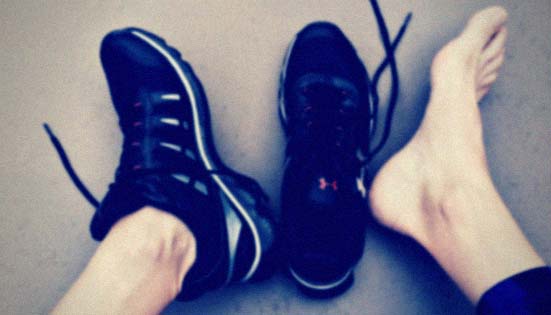
Take the padding away and try running this way and all the impact that the padding absorbs goes straight into your heel and travels up your leg through your shins, knees, hips, and lower back, which can easily cause impact-related injuries to these joints and tissues.
More info: Running form – Heel or Forefoot Strike
What typically happens when you ditch your shoes and try barefoot or minimalist running, is your brain automatically reacts to the increase in impact. That switches your gait to more of a forefoot landing rather than landing on your heel.
Landing ahead of your center of gravity
But what about the overstriding? Taking off your shoes does not change the muscle memory you’ve developed over the years you’ve been overstriding in your cushioned shoes. So what ends up happening is now you’re landing on your forefoot but still landing ahead of your center of gravity.
Why is landing ahead of your center of gravity such a big deal? Because it adds unnecessary stress to the areas of the body involved in landing. It is potentially causing a different set of impact-related injuries depending on where you are landing on your foot.
If you land on your heel ahead of your center of gravity, whether you’re wearing shoes or not, as mentioned above, that impact can cause shin splints, knee pain, IT-band strain as well as hip and low back pain. If you do not have the added protection of a padded heel shoe, that impact is intensified.
If you land on your forefoot ahead of your center of gravity, the foot rotates inward due to the biological design of our legs and feet, causing you to land on the outside edge of your foot. This is called a lateral forefoot landing, usually between the 4th and 5th metatarsal bones of the foot. These bones are relatively thin and not dense compared to the width and density of the 1st metatarsal bone.
Therefore, a lateral forefoot landing can cause stress fractures of these lateral foot bones, especially the 4th and 5th metatarsals.
Elastic structures of your feet
What about the flexible structures of your feet, the plantar fascia, and the Achilles tendon, when you land ahead of your center of gravity while running?
Because the foot is on the ground for a long time between landing ahead of your body, moving your body above your feet, and then lifting your foot behind you, the elastic structures of your feet are carrying all the load of running for a long time.
This isn’t a problem if you’re walking because the load forces involved in walking are half what they are while running. Therefore, if you land ahead of your center of gravity while running, you are adding extra stress to these flexible structures, which can manifest as injuries to these structures, also known as plantar fasciitis and/or Achilles tendonitis.
Change our running form
Therefore, to prevent these types of stress injuries to the lateral bones of the feet and the flexible structures of our feet and lower legs, it is imperative that we change our running form.
Two crucial aspects of barefoot or minimalist running form, or a more natural running style, are foot posture and cadence.
Healthy running is about maintaining good form, just as safe driving is about not hitting other cars.
Natural running foot posture is one where you land more on the inside of your foot than the outside or on the medial side between your 1st and 2nd metatarsal boneheads. You still want to land on the forefoot but between the big and second toes as opposed to the 4th and 5th smaller toes. And you want to land under your center of gravity and not ahead of it.
Increase your cadence
This aspect of natural running is a lot easier when you increase your cadence to about 180 steps per minute when counting both feet.
With a cadence this fast, it’s difficult to have enough time to land ahead of your center of gravity, and it reduces the stress on your foot and lower leg elastic structures because they are stretched for a minimal amount of time.
Some do run with perfect form no matter what they wear for footwear.
A faster cadence than this starts to reduce running efficiency, so use 180 steps per minute for best efficiency. That encourages a shorter stride, under your center of gravity, and minimizes loading stresses on your plantar fascia and Achilles tendons.
Running form needs to adopt
Getting back to the original question: Is barefoot or minimalist running as simple as ditching your shoes? No.
It might take months to adjust even if your stride and landing on the forefoot come naturally.
It is crucial that your barefoot or minimalist running form adopts the changes necessary to prevent impact- and stress-related injuries. You no longer have any cushioning protection under your feet.
It’s important to educate yourself as to what changes you need to make to your running form to prevent these injuries.
Your body needs to adapt
It is also essential to give your body a chance to adapt to these new changes.
- If you have significant changes to make to your form, you will probably not be able to continue running at the same mileage that you enjoyed while in your cushioned shoes.
- You are going to be using different muscles that are not accustomed to being used in this new way.
- You may also be requiring your flexible structures to stretch further than they have been used to stretching.
Give your body time to make these adjustments. Reduce the length and frequency of your runs, until your muscles become stronger. And also wait for your flexible structures to become more flexible.
Go out and run, and think how much fun it is. Isn’t that what running should be? Have fun.
Journey to health and wellness – where to begin

Your journey to health and wellness begins with building a lifestyle that supports it. You should make healthy habits and choices part of your daily lifestyle.
You do not need to fix your entire life all at once entirely. These changes can be made piece by piece.
Physical Fitness
The Office of Health Promotion in the United States plays a vital role in trying to keep the people healthy. They published Guidelines for Physical Activity as early as in 2008. Have we followed those guidelines?
>> Read more, and see the facts at the end of this post.
Guidelines recommend 30 minutes of moderate aerobic activity daily. Or a weekly minimum of 2 hours and 30 minutes for adults ages 18 to 64 years.
According to guidelines, strength training is recommended at least twice a week. You should train all of the major body parts, legs, hips, arms, shoulders, abdomen, back, and chest.
If you are not already physically active, including fitness activities into your life might first seem hard. But actually, it does not need to pose a significant challenge, as a wide range of nice physical activities meets the guidelines.
Examples of the moderate physical activity include:
- dancing,
- brisk walking,
- general gardening,
- bicycle riding and more.
Keep in mind, 30 minutes of moderate activity daily means just the bare minimum to gain health benefits.
By doing more vigorous activities, you get more significant health benefits. And by extending the time of physical activity, you also increase health benefits.
Examples of vigorous activities:
- Hiking
- Jogging at 6 mph
- Bicycling fast (14-16 mph)
- Basketball game
- Soccer game
- Tennis singles
To get health and wellness benefits of fitness activities, make them part of your daily lifestyle. Set aside time in your daily planner. Add a reminder to exercise on your phone.
The 2 most valuable things you can do are:
- show up constantly and,
- perform some level of physical activity.
Build the habit! Even if your exercise does not equal the full 30 minutes, you’re still building the constant practice of physical activity.
How to Succeed
- Start with an activity you will enjoy.
- Workout with friends, or join an exercise group.
- Every little action counts. Exercise for 20 minutes twice a day. Or exercise in 10-minute increments throughout the day. The minimum requirement was 2 hours and 30 minutes per week. You achieve it easily with those mini-exercises.
- Block out training time on your calendar.
Diet
Along with physical fitness, health and wellness link to a healthy and balanced diet.
About half of American adults have one or more chronic diseases, often related to poor diet.
Everything we eat and drink, the food and beverage choices we make day to day and over our lifetime, matters.
People who eat well earn a variety of health benefits:
- better weight maintenance,
- lower chances of developing diabetes or
- heart disease and,
- lower instances of illness.
As recommended by the 2015-2020 Dietary Guidelines for Americans, a healthy diet includes:
- fruits,
- vegetables,
- low-fat dairy,
- lean proteins and,
- unrefined grains.
The guideline also suggests lowering these:
- sodium,
- added sugar,
- trans fat,
- saturated fat and,
- cholesterol in the diet.
Create a healthy eating plan to maintain health and reduce the risk of disease.
More info: https://www.choosemyplate.gov/dietary-guidelines
Work on adding healthy choices to your meals and snacks, before you look to cut things from your diet.
Take a proactive, positive strategy as you make changes to what you eat:
- Drink a non-carbonated beverage instead of pop or soda.
- Choose unsweetened herbal tea which still provides flavor.
- Choose plain water or lemon water.
- On your meals, select brown rice instead of white rice.
Just as with exercise, small changes add up to a complete transformation into a more desirable lifestyle.
Keys to Success:
- Take one or two small changes in your diet each month.
- Experiment. Eating healthy needs to be enjoyable. Remember, it needs to be part of your lifestyle. Try foods and a variety of ways to prepare them. Enjoy the ones you like.
- Keep your daily menu varied. Take care that you don’t get bored with your diet. Take care not to drop out.
The connection of mind and body
Our emotional state can influence our food choices. It can also affect our level of physical activity. Our ability to maintain positive social engagement is also affected by our emotional state.
We want to too easily satisfy ourselves and reward centers in our brains with foods high in sugar and fat.
If we are stressed or unhappy, what happens? Many of us reach for fatty foods to make ourselves feel better.
Sometimes this is a conscious decision. But most of the times it is not.
Also, feeling angry, unhappy or depressed saps energy. And if your energy levels are low, you just don’t like to exercise or pursue some other physical activities.
There are many ways to challenge this cycle.
Physical exercises like yoga, pilates, tai chi and many others expressly nurture a healthy mind-body connection. Each of these activities uses movement tied to breathe awareness. That gives focus and calm to the mind and the nervous system.
Yoga includes breathing exercises and meditation as well. These activities build fitness and relieve stress.
Some mind-body activities, breathing exercises, visualization, and meditation, do not involve whole body movement. They focus on channeling mental activity and reducing stress.
It is essential to keep the body healthy and the mind in a state of balance to experience a sense of well-being. Balance does not mean you become a robot. It merely means you do not experience unrealistic highs or debilitating lows, like depression. If you are even-tempered, it makes it easier to deal with stress, adapt to change and maintain a healthy lifestyle.
Keys to Success:
- Choose a mind-body activity, which suits your lifestyle and temperament. Include it in your schedule
- For the best results, practice it consistently.
Make It A Habit
How to form a new habit? Some say it takes about 30 days of consistent reinforcement to make a simple action a habit.
More complex actions, like building an exercise or meditation routine, or dietary changes, can take much longer.
The rate of success for more complex changes can be variable. Do not end your quest for health and wellness if you are not seeing immediate results. The key to acquiring new habits is consistency and persistence. You can reach your goal by being consistent.
So what is the level of our physical activity?
Some facts and statistics about physical activity
- Children – only one in three are physically active every day.
- Adults – less than 5% take the recommended 30 minutes of physical activity each day. Only one in three take the recommended amount of physical activity each week.
- Over 65 years old – only about 30 – 40 % are physically active.
- More than 80% of adults do not meet the guidelines for both aerobic and muscle-strengthening activities. More than 80% of youths do not do enough aerobic physical exercise to meet the guidelines.
Source: https://www.hhs.gov/fitness/resource-center/facts-and-statistics/index.html
Summary
Aim for at least 30 minutes of physical activity every day.
Try to find the time for some regular, vigorous exercise for extra health and fitness benefits.
Minimise the amount of time spent sitting. Break up long periods of sitting as often as possible.
“Doing any physical activity is better than doing none.”
The Minimalist Running Philosophy: What You Need To Know
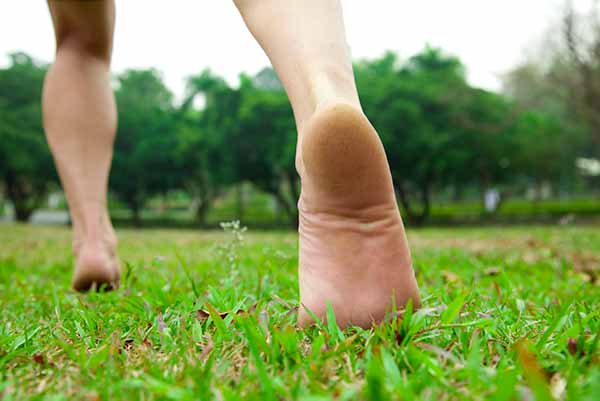
For decades, running shoe companies have traveled down a path of developing and selling shoes with the latest and greatest technologies. Different shoe models through the years have focused on cushioning, stability, motion control, and other functions that most runners considered desirable, if not downright necessary, or some combination of those features.
But in the last few years, a new running shoe philosophy has also taken hold of the philosophy that less is more.
This has come to be known as the minimalist running philosophy.
In short, those who follow the minimalist running line of thinking will point to the fact that humans have been walking and running for thousands of years, and for all but just the last few decades we’ve been doing it in basic footwear or no footwear at all. Because humans have been walking and running for so long without running shoes, our feet, legs, knees, hips and virtually every other part of our bodies that have to do with forwarding motion are already designed or evolved to work optimally.
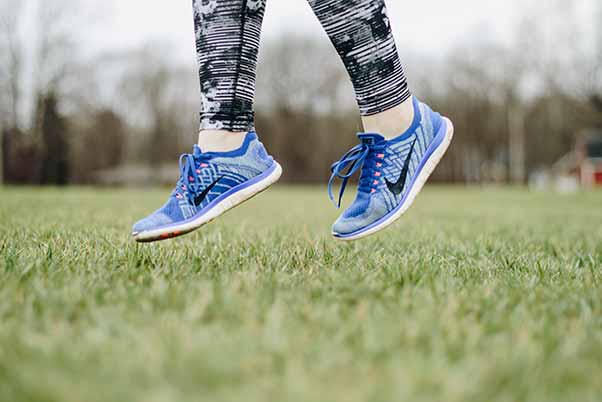
The thinking is that by putting our feet into running shoes that protect us, we’re actually doing harm to ourselves in a couple different ways. First, by the shape and height of most running shoe soles, running shoes actually teach us to run improperly. That is, by putting lots of cushioning in the heel, and making the heel higher off the ground than the front of the foot, the shoes encourage us to strike the ground with our heel, with the foot landing far ahead of the body’s center of gravity. Recent studies have shown that heel striking puts a dangerous amount of stress on the joints, even if the strikes are cushioned with running shoes.
Runners who adopt a more minimalist approach to their running shouldn’t expect to maintain their prior work out levels when they switch to a new type of footwear.
In contrast, when people run barefoot, they naturally gravitate towards a stride that has them striking the ground with their midfoot first and having their feet land almost directly under the body’s center of gravity.
As far as form goes, the closer to barefoot, the better.
In fact, some writers do prefer to run a significant portion (or perhaps even all) of their workouts barefooted. Clearly, this will require a period of adjustment as a runner’s body and form adjusts to the new technique. Furthermore, using common sense and listening to one’s own body is essential. If you like to run on gravel paths or roads, then going entirely barefoot isn’t probably the best idea.
Investing in minimalist shoes is a better choice than instantly transitioning to shoeless running.
A related claim in the minimalist running philosophy is that by putting so much cushioning material between the foot and the ground, it becomes virtually impossible to listen to the body’s own feedback about whether the ones running form is efficient and smooth. Besides, traditional running shoes that have many different motion control features are thought to prevent the body from running in the way it naturally wants to.
Most individuals who follow the minimalist running philosophy would not claim that the best or safest course of action is to merely find the simplest, lightest and thinnest pair of running shoes (or just go barefoot) and start running a dozen miles a day because of it’s natural.
We’ve spent practically all of our adult lives in thick and inflexible shoes, so a period of adjustment will be necessary.
Runners who adopt a more minimalist approach to their running shouldn’t expect to maintain their prior work out levels when they switch to a new type of footwear. But with time they may be able to reap the benefits.
>> Further interesting reading: Why I Shifted Toward The Minimalist Philosophy
Seven Reasons To Barefoot Run
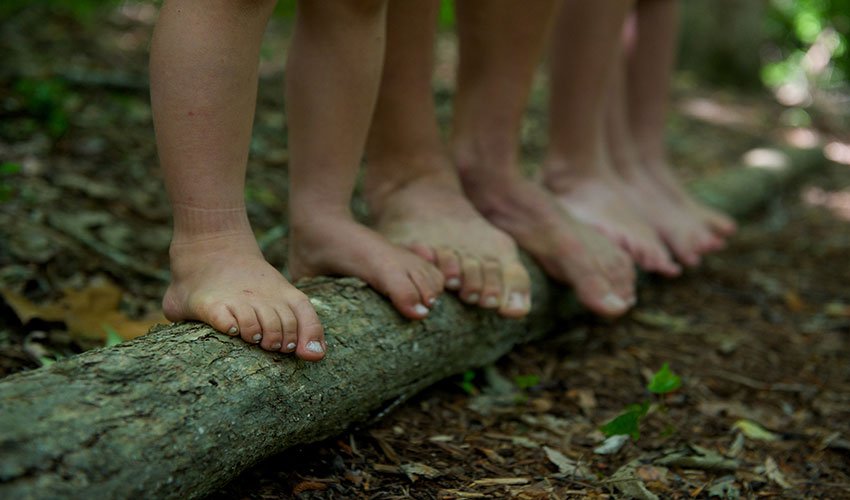
There are many reasons to try running barefoot for the first time – here our seven most favourite!
1. MOTHER NATURE
One of the greatest reasons to decide to run without shoes on is the feeling of becoming one with nature.
Running in grass, or sand, ultimately helps you experience nature more fully. This is something that you can never do properly with shoes on.
Barefoot running brings a connection with the ground beneath your feet like no other thing on earth does.
Put simply – it feels great!
 2. LAND NATURALLY
When you run with shoes on, you actually place a greater stress on your foot.
This means your heel will land first, with a harder strike.
The best way to run, according to experts, is to land on the middle or the front of your foot.
A study has found that people who run with shoes hit the ground with the weight of all their leg. This means it is nearly triple the impact of running without shoes.
There is a lower impact when you run barefoot. This is because you naturally run in a way which distributes the weight more evenly over the entire foot
3. IMPROVED POSTURE
Ultimately, you will get a better posture from running without shoes.
This will impact on your health overall.
Improved posture means fewer problems, later down the line, for your back and spine.
4. FEEL FREE
Feeling free is often the number one reason that barefoot runners cite, for their decision to run shoeless.
You know how kicking off your shoes at home is liberating? Well, it is just the same when you are outside.
Being free of the constraints of socks is a good feeling for many, barefoot running just takes it one step further.
The air is cooling as you run and your senses grow more alert.
It also helps with mindfulness.
You will find you become more aware of where you are, your physical position and your immediate surroundings.
5. LOVE YOUR KNEES!
When you run in shoes, there is a tendency to place a greater weight upon the ankle.
This, in turn, can lead to a higher chance of twists and sprains.
It is also not just the ankle which has more stress placed on it. It is the kneecap as well. Knee pain is a common ailment for many runners (in shoes).
This is less likely to occur when running barefoot. One reason for this is because you take lighter strides when you run without shoes and therefore, place less pressure on your knees, ankles and other joints.
6. STRENGTHEN YOUR FEET!
Did you realise that shoe wearing is actually weakening your feet?
This is obviously even worse when the shoes you have on do not fit correctly.
Getting a perfect fit is difficult, for many people.
Wearing poor fitting shoes can actively damage the foot, stunting its growth and in some cases, squashing it.
It can also cause pain and other podiatry conditions.
The muscles grow weaker and the chances of an ankle injury is more likely. And it can actually shorten your tendons.
And this is just for walking in!
As running is even more high impact, it is important to be kind to your feet.
Running barefoot helps to strengthen the muscles in the foot and puts it back into a natural shape.
7. SAVE YOUR MONEY!
If you’ve ever added up how much you have spent on running or training shoes, then you will know this could be a sobering figure!
Brand names don’t come cheap. And they aren’t necessarily better for your feet either.
If you are contemplating running as a pastime, hobby or fitness activity, think twice before rushing out to buy expensive sports shoes.
You don’t actually need them!
Barefoot running may be beneficial for some people. People desiring to transition to barefoot running should start slowly, gradually increase time spent barefoot, and use proper mechanics.